I realize it has been a while since I wrote my last blog entry, and to any regular readers I apologize. We have been on the move a lot lately. We have been spending on average 3 nights in each location and this doesn't leave a lot of time for blogging. It doesn't mean I have not seen anything worth writing about.
Currently we are docked in Piraeus, Greece as part of an 11 day Eastern Mediterranean Cruise aboard the Holland America ms Eurodam. This is my first cruise and I wasted no time settling in and have found it quite easy to enjoy myself aboard this magnificent vessel!
As you only have hours in any given port of call you do not have a ton of time to experience each place we visit. It is for this reason I would like to introduce a series of upcoming blog entries called 'Landscape Architecture at a Glance' for select ports of call. Each entry will be an abbreviated account of unique examples of design and construction I have encountered along our cruise.
As anyone else who has been on a cruise recently can tell you Internet on the boat is outrageously expensive. Therefore these entries may not be able to be published until after the cruise. In the meantime I will continue to enjoy each port, room service, the 2 pools and the beautiful Mediterranean weather.
Translate
Sunday, May 5, 2013
Monday, April 22, 2013
Salzburg, Austria: Maintaining the 'Gartens'
| View of Salzburg Suburbs and the Alps |
Salzburg is a smaller Austrian city whose suburbs reach out to the base of the Alps. As with many of the other places we have visited it has a very interesting 'Old Town' where some historic buildings still remain. Some buildings have been preserved and used as an educational tourist attraction while others have been rehabilitated and turned into residences, shops, or restaurants. It is really neat to see modern stores inside a building dating back to the days of Mozart.
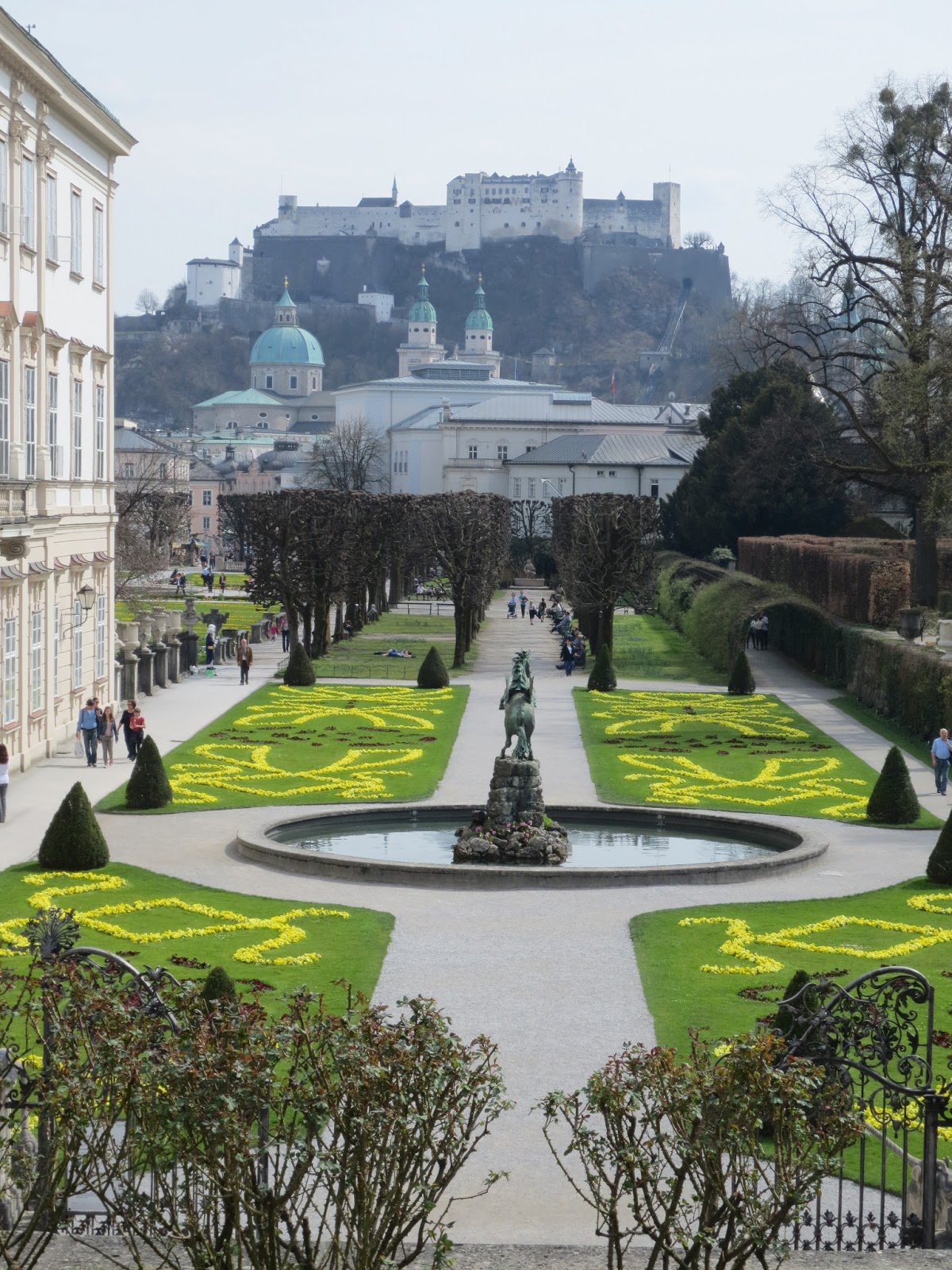
On the opposite side of the river from the 'Old Town' lies another gem belonging to this city, Mirabellgarten. Readers who would like to delve more into the history and background of this beautiful garden and the adjacent palace can click HERE; just don't forget to translate the page to your language, unless of course you are fluent in Deutsch. In addition, according to someone on yelp.com and confirmed after a search on YouTube.com, this is where Maria and the children sang 'Do-Re-Mi' in The Sound of Music, and you can take that to Jeopardy.
Although the 'garten' is incredibly beautiful and incorporates several styles of design, I chose to focus on this location for one very particular reason: MAINTENANCE. As a Landscape Architect I find the amount of maintenance that will be required of a completed project tends to make or break a design even in the very early stages. In my opinion this happens A LOT more often than it should.
Let me give you an example. A client hires you to design a park. You attend the initial meetings, get the idea for what they want, visit the project site, list the opportunities and constraints of said site (blah blah blah). Anyways, you get to work; pen flying, mouse clicking, you have brilliant ideas and they are flowing from your brain to you fingers to paper. You come up with a few concepts and take them to the client. You have A) a basic design that simply covers their needs and nothing more, B) a middle of the road design with a little pizzazz and C) the 'creme de la creme' your favorite design providing everything they want and a little more in a very unique, elaborate, but not over the top way. You are excited and really push for design 'C'. They listen to your whole pitch, but choose design 'A' or if you are lucky design 'B', but with some value engineering of course. Why did this happen? Money? Maybe, but more often than not having a project that appears to require more routine maintenance than what a client currently does can make the difference between designing and building another 'park' and a really unique space that has the potential to draw users from all over.
There are many different areas within Mirabellgarten and all require special attention to keep it looking its best. If you take a look at the map below this gives you an idea of the scale of the garten and diversity (and lavish extent) of styles.
![]() |
| Mirabellgarten (courtesy of Google Earth) |
The use of materials is simple but incredibly elegant. There are stone paths directly adjacent to lawn spaces. There is steel edging separating the two materials to create distinct separation and sharp lines. In the lawn areas, thin 12" flower beds are planted (every year) with annuals. These beds twist and turn into very ornate designs. In some smaller featured areas around the fountains steel edging is used again to create designs in different colored stone. While we were there we saw workers attaching smaller flowers to stakes in order to get them to grow properly. We also saw workers removing some of the colored stone in certain areas. They were doing this to place soil and install lawn. That's right, in the middle of a bed of stone they were introducing lawn. In the Biz we call that, 'a nightmare.' All of the workers seemed genuinely happy. They also seemed passionate about what they were doing. They could see the end result was a beautiful place that people from all over the world come to enjoy! Take a look at the pictures below to help illustrate all of this.
| One of the Many Entrances to Mirabell Hohensalzburg Castle in the Background |
| Intricate Lawn Areas with Ornate Flower Beds (Beds are Flush with Lawn) |
| Lawn and Flower Areas Trimmed Boxwood Garden in Background |
| Focal Plantings at Sculpture With Stone and Lawn |
| Garten Worker Removing Grey Stone to Install Lawn (He is Smiling I Promise) |
| Ground Level to Show Steel Edging (And Happy Worker) |
| Inner Shape After Removal of Colored Stone Awaiting Topsoil |
| Inner Shape After Removal of Colored Stone Awaiting Lawn (Aforementioned Nightmare, but Gosh it Looks Good) |
| Lawn Area with Multiple Flower Types |
| Boxwoods, Holly Trees and Annuals in Separate 'Garten' Room |
| Boxwood Hedges, Lawn and Stone |
| Another Happy Worker Installing Plant Stakes No Joke This Guy Was Not Just Smiling for the Photo |
| Parting Shot of the Lawn and Flowers |
Please don't get me wrong, not all projects get squashed due to maintenance concerns. However, I do believe that with the right amount of education and the selection of the right people for the job maintenance may not be an issue. To return to the example I gave before it's not all about the client. Yes, it is about what they want in the park, and of course its about whether the funds are in place to construct such a place. However, if the people who will be in charge of maintaining the park do not care about the park, do not have a desire to be educated about how to care for some of the new features in the park, are overwhelmed with the current amount of work to be done, are downright lazy, or any combination thereof, the park will not work. It will be a beautiful work of art on paper, and will look great for about one week after construction. Great places take a lot to keep them that way, but to me the return is obviously worth it.
Saturday, April 20, 2013
Intermission: Coffee in Italy
So here we are, we have passed
the halfway point by over two weeks now! That
is said with quite a bit of sadness as the time has been flying by and the
places we visit just keep getting better and better. All of the pieces of the puzzle have been
sliding into place as we fill in those blanks that before we left sounded like,
“Well we arrive into Rome and then we have seven weeks to get to Istanbul,
probably by train and bus mostly.” Now
our story sounds more like this. “Well
we flew into Rome for three nights, and then we made some great new friends in
Sacile (pronounced ‘Sah-Cheel-Eh) who then drove us down to Venice. We spent two nights in luxury on the Grand
Canal in Venice before taking a bus and then a train to Salzburg where we will
spend three nights before heading to Neuhofen to stay with someone we met along
the way for two nights. She offered to
drive us to Vienna where we will stay for three nights before heading to Prague
for four nights. After that we will fly
back to Rome to meet Andrea’s parents for two more nights before heading out on
an 11-night eastern Mediterranean cruise together.”
There is more, but you get the point, the
four month unplanned adventure is filling up with plans! In the past 2.5 months we have
had a lot of experiences, every minute of every day is something
different. This whole experience started
as a dream in Andrea’s mind. I have to
give her 98% of the credit. I get 2%
because it took A LOT to convince me that this was remotely feasible before I
was 100% on board. However, here we are
after years of plans, changing of plans, and saving, two and a half months into
this great adventure.
When we began to
plan this out we realized (as I mentioned much earlier in my blog) that we
would need to cut back in a lot of areas to be able to save enough to enjoy
this trip. For me that meant my Blu-Ray
movie acquisition would have to slow way down.
It actually came to a screeching halt, and I missed it a lot less than I
thought. For Andrea, less caramel
macchiatos at Starbucks. Together we
made fewer purchases, and cut way back on our dinners and drinks out. Whenever I was visibly annoyed at Andrea
saying maybe we shouldn’t buy this, go here, or eat that she would say, “that
could be a coffee in Italy.” Well it
kind of stuck and that was our little “thing” as we saved. No Starbucks now meant a “coffee in Italy.” No dinner out on a certain night meant
several “coffees in Italy.” I am sure
you get the picture. Well my friends, I
have had “coffee in Italy” several times, and even two in one sitting
once. All I have to say is it was delicious
and totally worth the sacrifices and wait.
Every single thing we have done has been amazing, and I can’t help but
smile thinking about what we have packed in so far and what is coming up!
So as I sit here on the OBB Train
from Villach to Salzburg, Austria after a 2.5 hour bus ride from Venice,
sipping my vino rosso in a juice box, listening to The Lumineers as we wind
through the Alps, I cannot help but smile.
Prost!
Tuesday, April 9, 2013
Hendaye, France: A Small Town with a Big Waterfront
I figure now, now that we have moved on from San Sebastian to Bilbao, back to Madrid and are gearing up to depart Rome (for the first of our 3 times here on our trip), would be a good time to publish this post about a little side trip we took from San Sebastian.
After a four hour bus ride from
Barcelona to San Sebastian, Spain, a 15 minute train ride and a 30 minute walk
we arrived in Hendaye, France. In our
original plans we were not planning on making it to France but as our three
weeks in Spain led us to within minutes of the border, we couldn't pass up the
opportunity. Hendaye is a small town on
the Bay of Biscay in Atlantic Ocean in south western France. There are equal parts German and Spanish
architectural influence with a smidgen of English and French style thrown in as
well. In addition, being so close to the
Spanish border we heard more people speaking Spanish than French. I didn't know what to expect in this town,
but as I studied French for 5 years in Middle School and High School I was
excited to visit France for the first time.
After walking around for a while
it was evident that this seasonal town capitalized, incredibly nicely, on their
waterfront. As you can see in the map
below, there is a large bay housing a marina leading to the canal which
ultimately leads out to the ocean. There
is a pedestrian walkway along the bay and a separate lane which is only for
bicycle use. This has been something I
have seen a lot of, that not only is there a heavy focus on pedestrian traffic
but there are usually separate lanes for walkers and bikers. The route along the bay is very nice, but the
oceanfront promenade was the highlight of the town for me.
![]() |
| Map of Hendaye, France |
| Bay Boardwalk 1 |
| Bay Boardwalk 2 |
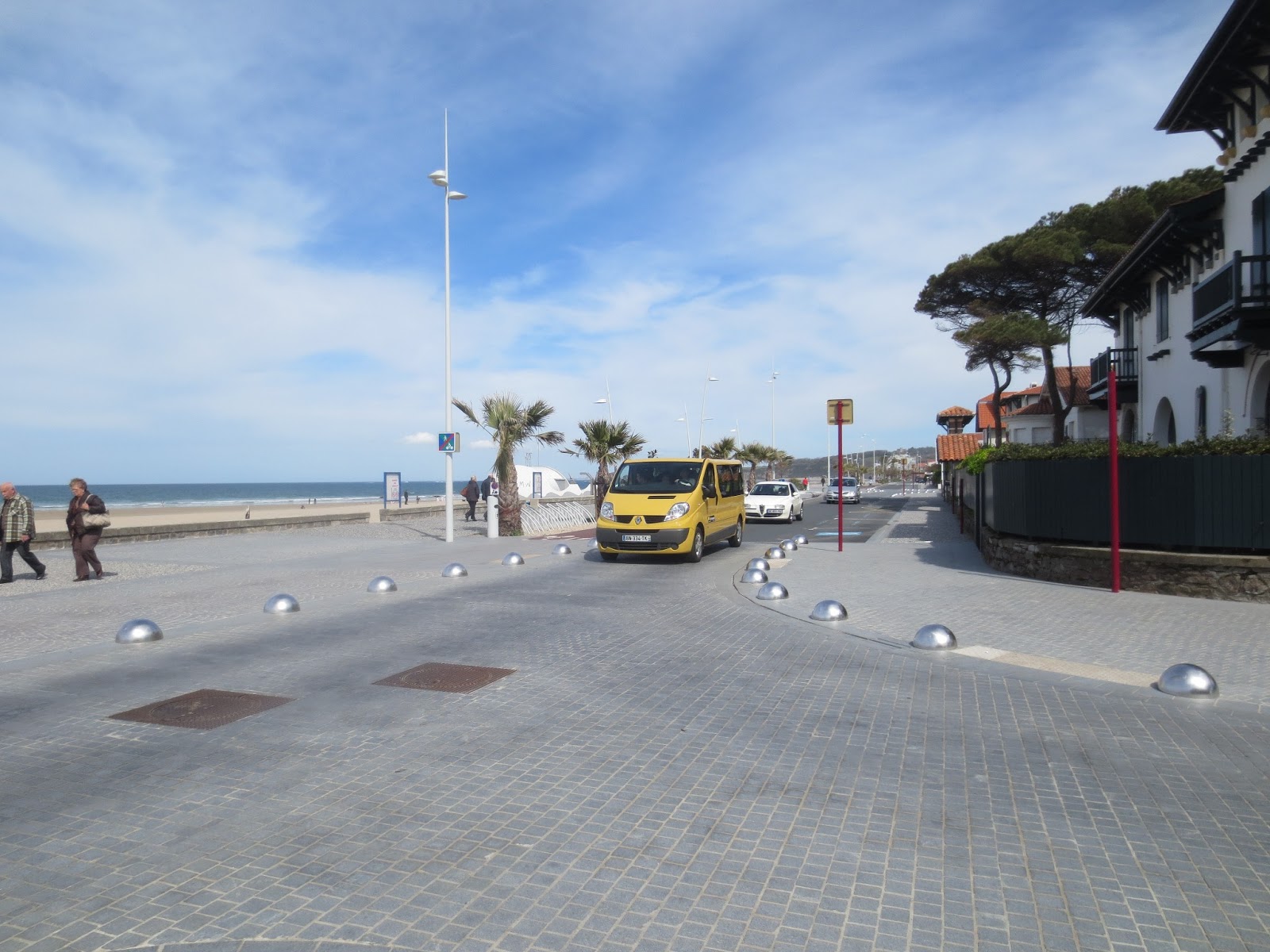
The route along the bay is very nice, but the oceanfront promenade was the highlight of the town for me, well besides the cappuccino and crepes with chocolate. Between the hotels, shops and
other buildings and the ocean there is about 60’. Which is a rough estimate as
I didn’t bring my 100’ measuring tape on this 4 month adventure. 40’ of this overall 60’ width is dedicated to
pedestrians. The day we visited Hendaye was quite
overcast, and there were still loads of people surfing and using the promenade. There were plenty of places to sit and watch
the ocean, many bicycle racks to accommodate the even greater summer population
and a central plaza with wide stairs leading down to the beach.
In this promenade alone there was
a wide range of materials used. There
was sandstone in the wall directly along the beach. There was exposed aggregate in the 20’
pedestrian walkway, and gravel beneath the brushed aluminum bicycle racks. The
materials chosen for this space added to its how unique it is. The benches of brushed aluminum with wood
slats for the seats were set on rectangular areas of composite wood
decking. The bicycle lane was colored
concrete and separated from the road by a simple but very nice granite block
curb planter.
You find many seaside towns using
boardwalks, walkways or path system along their waterfront but the overall
scale of the space and the materials selected make the difference between a good
walkway and a great boardwalk. Take a look at the photos below and see what you think about the spatial layout and the materials selected for this oceanfront promenade.
| Looking West (Rt-Lft 6' Sidewalk, 20' Parking/ Travel, 2' Curb and Planter 8' Bike Lane, 8' Tree Lawn/Bench Pad/ Bike Rack/ Gravel Pad, 20' Pedestrian Walk, 2' Wall, Beach) |
| Close Up Looking West |
| Sculptural Concrete Seating |
| View Looking East (Notice the Steel Vehicle Stoppers to Compliment the Metal Used in the Other Elements) |
| Open 'Plaza' Area an Steps to the Beach |
| Wide View of Street, Promenade, and Ocean |
Sunday, March 31, 2013
Barcelona: Land of 1 Million Parcs
First off welcome to Barcelona! You should know that it is pronounced BarTHelona. Most of the words with 's' soft 'c' and 'z' sounds in the Spanish (only Spain, not South America, Mexico or other Spanish speaking countries) vocabulary are replaced with the 'th' sound. If it sounds like you have a lisp while saying it, you are thaying it correctly. For instance: 'gracias' becomes- grathiath. Get it? Got it? Good.
For those of you who know me, know I studied at SUNY-ESF (or the State University of New York-College of Environmental Science and Forestry, placing it in the Guinness book of World Records for the longest university name in the world). I am still featured on the college website leaving a lasting legacy. (http://www.esf.edu/physicalplant/services.htm -Half way down on the right side. I am in the Scooby suit.)
I majored in Landscape Architecture, obviously, and was drawn to the school due to its, literally, world renowned 'off-campus' program. Our off campus semester was totally unique in that we didn't go to another university to take classes, but rather we wrote a study in the second semester of our fourth year, which we were then to carry out in the location of our choosing. For instance I studied in Australia and compared the "Sense of Place in Waterfront Resort Design". Sound like an excuse to go to Australia swim in the ocean and stay at sweet resorts? Well you are absolutely right! However I did get a lot out of my study aside from a sweet tan.
There is an excellent faculty at ESF and they come visit you during your off campus to answer questions, help you with your study, but I believe primarily to take a paid trip to an exotic locale. There is a certain professor who, although this is just me speculating, I believe bribes students to ensure a Barcelona group each year. He then accompanies this group every year to Barcelona and has become quite the expert on the city.
After visiting Barcelona for only a day, it easy to see why anyone, especially a Landscape Architect, would come back to this place year after year. It is an absolute mecca for designers of all backgrounds. Barcelona (as mentioned on the 'Barcelona Bus Turistic') is 'constantly changing to ensure a better quality of life for not only those living here, but tourists as well.'
As I walked through the city the first day blog after blog popped into my head. I could easily do a blog for each park! The titles flooded my brain! Parc Güell: Just a 'Gaudi' Walk in the Parc, Ramblin' on Las Ramblas, View from the Top: Montjuic in a Nutshell, Plaça Catalunya: In the Middle of it All. A blog for each park? As the great female African American pop culture icon of our time said: 'Ain't nobody got time for that.' (http://www.youtube.com/watch)
It is very refreshing to see the amount of well designed public places in Barcelona and how great the range of styles is. The Museu Nacional d’Art de Catalunya which is housed within the Palau Nacional has an incredible grand plaza lined with countless fountains leading up to it. The sheer size of this place is awe-inspiring. There are wide open plazas in front of massive Cathedrals in the Barrio Gotic. Las Ramblas is an incredibly wide pedestrian mall lined with small artisian kiosks bordered by one way street traffic and flanked by stores. Parc de Diagonal Mar is a fantastic modern park that meanders 'diagonally' from the beach inland along stone pathways, over elevated bridges and boardwalks, around water features and under unique shade structures. Port Olimpic is in the middle of the 'Olympic Village' from the 1992 Barcelona Olympics and showcases shops, restaurants and a beachfront boardwalk the stretches on for miles. Of course you cannot forget Parc Güell. Another of Antoni Gaudi's works, although it had originally been planned as an English style housing community before the funding was cut short. It shows that maybe, just maybe, some architects know a little bit about site design. :) The following are pictures showing a few of these places.
Plaza in Front of Palau Nacional
Las Ramblas
| Mercat off of Las Ramblas |
| Shade Structures and Stone Path |
| Wood Bridge and Lighting |
| Earth Berms in the Sun |
| Gigantic Metal Slides for Children...or Adults |
Port Olimpic
| 'Sustainable' Building Model |
| Port Olimpic and Beach |
Parc Güell
| THE Gaudi Lizard |
| Handcrafted Columns and Bench |
| Stone Wall and Stairs Amidst Lush Gardens |
| One Happy Landscape Architect |
This is only a sampleing of the public spaces within this magnificent city. It is really great to see the preservation of the historic areas as well as the support and incorporation of modern art and architecture. The way they intertwine is quite marvelous and creates a unique fabric that makes up the city that is Barcelona.
Wednesday, March 27, 2013
Sevilla, Spain: City of Tile and Stone
| Plaza de Espana |
Hello, hello, hello! Since the last post we have covered some serious distance. We crossed the ocean to our second continent
and have been cruising throughout Spain for over a week now! We flew into Madrid and spent a few days
there. Despite mixed reviews from other
people about Madrid we found it to be a fantastic city. Andrea and I realized
that part of our enjoyment of this city was the extreme contrast after travelling
within South America for a month and a half.
We really did enjoy ourselves but only 2 short days later we moved on
to Toledo. This was a much smaller city, very medieval. Small streets,
smaller alleys, and even smaller sidewalks.
It was easy to get lost, but that way we were able to explore that much
more, even if by accident. After three
days and some excellent tips from our gracious hosts (another excellent AirBnB
location) we made our way from Toledo back to Madrid and then took a six hour
bus ride to the southern city of Sevilla (or Seville in English).
Sevilla is another old city in
Spain filled with incredible beauty. The
amount of old stone and brick buildings is overwhelming. Every alley and every turn unveiled to us another beautiful building. There is stone everywhere, stone building walls,
old stone columns, cobblestone streets, stone bridges, and stone pillars
incorporated into wrought iron fences. It
is simply beautiful. Check out the following
pictures of the different uses of stone throughout the city.
| Stone Pillars at Plaza de Espana |
| La Catedral |
| Rear of Catedral Notice the Arab Influence in the Shape of the Windows Center Right |
| Stone Light and Fountain Outside of La Catedral |
| Celtic Influence at the Walls Surrounding the Alcazar (Palace) |
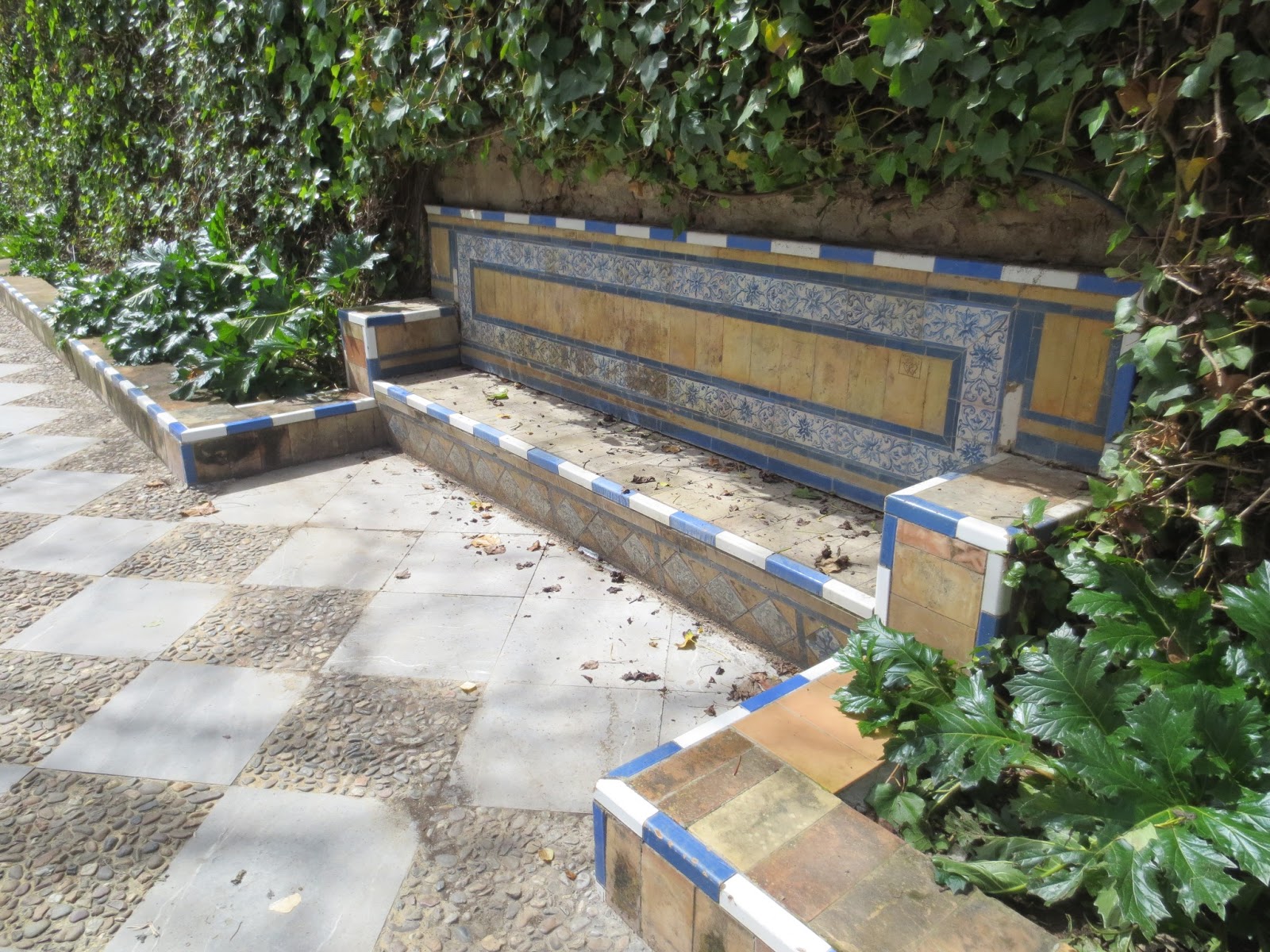
After walking around for a little while longer I started to notice something else: color. Little tiles incorporated into walls, columns, and benches. I started to see more and more. I had never seen tile used this much outdoors anywhere else! Even the Arab and Spanish influence on this area was evident in the tiles.
There were simple colored tiles
installed in sidewalks, street name tiles embedded in the side of buildings,
elaborate colorful mosaics, and even pieces of alternating white and blue tile
installed as coping on a 12” curb planter.
It was beautiful and unique. In
Buffalo the use of this much tile would most likely not work, as the fear of
vandalism, or the impact of weather would undoubtedly cause designers and
clients to shy away from using it. The
main thing that surprised me was the use of tile as coping. Edges of walls, curbs and railings are
typically ‘protected’ by metal ‘skate stoppers’ to prevent skaters from
grinding on them. They would certainly not be accentuated by the use of colorful tile. I do realize that this was installed a long
time ago, but even still people realize that it is important and do not damage
it in any manner. It was really interesting.
On our second day we went over to the Plaza de Espana which was built in 1928 for the Ibero-American Exposition of 1929 which was held in the adjacent Parque de Maria Luisa (you can read more here if you like: Plaza de Espana-Wikipedia).
I had never seen more ceramic tile in my entire life. I had
even thought about doing an entire post about this plaza. It was incredibly ornate and the ornate building
surrounded a large fountain and beyond the fountain was a gigantic park! Sheer beauty. The pictures that follow are taken throughout the city to show the wide range of places where the tile was used.
| Tile Clad Ballisters on the Bridge Railing at Plaza de Espana |
| Castle Tile Detail at Plaza de Espana |
| Tile and Stone Bench at the Alcazar Gardens |
| The Tile Coping! |
Sevilla was amazing, but as is the theme to this trip: On to the next! Sevilla by morning and Barcelona by night.
Subscribe to:
Posts (Atom)